
Tony D'Souza, who is consolidating his reputation with The Konkans, his second novel and Ashutosh Varshney, a distinguished professor of political science are among five India-origin Guggenheim fellows for 2008 in Canada and America.

Talks on global climate finance virtually ground to a halt last week at COP29, the annual United Nations (UN) Climate Change event in Baku, Azerbaijan, as the developed world, led by the European Union (EU), and developing countries including India, Brazil, South Africa, and a clutch of island nations and African countries faced a wide chasm between their expectations. This has raised doubts about whether an agreement can be reached this week or whether talks will spill over to COP30, to be held next year in Benem, Brazil.

An IIT Roorkee graduate, Chandran joins a distinguished group of 24.
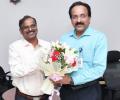
Narayanan has a long and distinguished career at ISRO, having played a key role in several important missions, including Chandrayaan-2 and 3, and the Gaganyaan programme.

Four-time Odisha MP Pinaki Misra's wedding to firebrand TMC MP Mahua Moitra in a quiet, intimate ceremony that chose privacy and tradition over fanfare, was a reflection of his personal style.

The Battle of Lhagyala on November 23, 1962, fought by the 4 Rajput Regiment against the Chinese PLA, remains a forgotten chapter of heroism, with no survivors left to tell their story.

India's only representative in the ICC Elite Panel of Umpires, Nitin Menon, has opted out of officiating in the Champions Trophy in Pakistan this month due to personal reasons.

Shaheed was Manoj Kumar's first patriotic success. This small-budget black-and-white film had enormous impact, besides laying the foundation for Manoj's famous flag-waving Mr Bharat image that was strengthened by a string of subsequent films like Upkar, Purab Aur Paschim and Kranti.
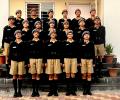
Barely out of their teens, the first batch of girls will graduate alongside 300 male cadets from the National Defence Academy.

After the 1962 War with China, there was a demand to forge greater defence cooperation between India and the West. One such voice was that of Sudhir Ghosh, a distinguished MP, to tie up strategic cooperation with the USA immediately after the Chinese attack on India, recalls Rup Narayan Das.
It may not be desirable in the 21st century, in the context of the emergence of human rights as a powerful emotive factor and of India's rise as an important player on the regional and global scene, to place self-imposed restrictions on the way we deem fit to vote on human rights resolutions, says Satish Chandra

Lee Jae-myung's decisive victory in South Korea's snap presidential election marks a major political shift driven by public backlash against authoritarian, with significant implications for domestic reform and the future of the US-South Korea alliance, observes Dr Rajaram Panda.
Apart from S M Krishna's performance in Islamabad, a perusal of the statements made in recent weeks by the Indian side reveals an unfortunate lack of precision in the use of language.
The major substantive lesson that we should draw from the foreign minister-level talks is that Pakistan is not serious about addressing our concerns on terrorism. This should have been clear to us long ago because we have been talking to Pakistan on terrorism ever since 1997, says former deputy national security advisor Satish Chandra.

Why can't the Indian government propose to the Chinese a corridor circumambulating the Holy Mountain where people from both sides could perform the yatra again? asks Claude Arpi.
'This is in its own interest.' 'Only the State must have the monopoly of power in the country.'
'Militias have no place in democracies,' says Shuja Nawaz, Distinguished Fellow at the Atlantic Council, the Washington, DC-based think-tank.

'There is uncertainty regarding job opportunities for our children after they serve for just four years under the Agnipath scheme.'

Nirupama Rao, the former Indian Ambassador to the US, has been named as the 'Meera and Vikram Gandhi Fellow' with the Brown-India initiative at the Watson Institute for International Studies.

The Sabarmati Report is so flimsy in its execution, taking offence to it would be dignifying its existence, notes Sukanya Verma.
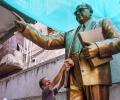
On the 134th birth anniversary of the chief architect of the Indian Constitution, Utkarsh Mishra revisits three incidents from Dr B R Ambedkar's life that lay bare the deeply entrenched nature of caste prejudice.
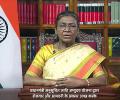
'Today, let us reaffirm our commitment to strive to realise Gandhiji's dreams. His watchwords, truth and nonviolence, will continue to remain relevant for the whole world. He also taught us that rights and duties are but the two sides of the coin - indeed, the true source of rights is duty. Today we recall his lessons in compassion too - compassion not only for our human neighbours but also for our other neighbours, namely, flora and fauna, rivers and mountains.'
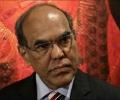
In his new role, Subbarao will take part in various activities at NUS Business School, the Institute of South Asian Studies and the Monetary Authority of Singapore.

If confirmed by the Senate, Garcetti, 50, would replace Kenneth Juster, who served as India's Ambassador to the US during the Trump administration.

One of two Indian Americans honorees Dr Deepak Srivastava is the director of the Gladstone Institute of Cardiovascular Disease and Wilma and Adeline Pirag Distinguished Professor in Pediatric Developmental Cardiology at the University of California at San Francisco.

Here is the Brahma Mantra for mankind. So long as the world has leaders with judgement -- humane, compassionate, and no-nonsense in their thinking -- natural intelligence will prevail, notes R Gopalakrishnan.

Senior journalist A Surya Prakash was on Tuesday appointed chairman of the Prasar Prasar Bharati Board, filling a post which had been lying vacant for the last six months.

'Today, if someone spits on us, we are ready to kill them, but these men, without raising a hand, led the country to freedom and that's easier said than done.;

A committee headed by Patel recommended retail inflation targeting and a monetary policy committee.
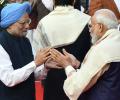
While Narendra Modi spent fewer days abroad than his predecessor -- 275 days versus Dr Singh's 306 - he has travelled more widely than any other Indian PM.

"One, we told the Canadians that this is not the Government of India's policy," Jaishankar said. "Two, we told the Canadians saying that look, if you have something specific, if you have something relevant, let us know. We are open to looking at it," Jaishankar said while responding to a question from former US ambassador to India and CFR Distinguished Fellow Kenneth Juster, in his first public comments on the issue.

Looking under the hood, I see India on the terrible, but commonplace, road to prosperity failure, warns Rathin Roy.

In cyber security, India's main concerns are Pakistani and Chinese espionage. Which is exactly why the US needs to build up partnership with India.
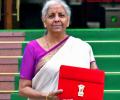
'They think quick fixes like internship in the private sector will help. 'In fact, internships have been going on for the last one decade.' 'In 2014-2015 itself, we had a ministry of skill development. None of the programmes have yielded results, still they are continuing with such schemes under some other name.' 'We don't see any seriousness on the part of the government to attack the problem of unemployment.'

It is high time the Indian government signalled discomfort with the UK providing refuge to those accused of financial crimes in India, states Jaimini Bhagwati.

'It is commendable that India is able to persuade all sides.' 'It shows that India counts and finally, we are reaching a position where we can find a place in the sun at the global level.'

Celebrate the weekend with Shah Rukh Khan and more on OTT.

'China seems more intent on creating a new world order rather than shaping the existing one.' 'India is of course, at this moment in time, aligned with the West-led order because of China's full-spectrum aggressive behaviour towards India.'

'The world is watching carefully. The choices India makes today have consequences beyond its borders.'

'The Weather Channel argues that India faces the gravest challenge: Climate change-induced health vulnerability.' 'This is an issue often neglected, alerts Claude Arpi: "Prolonged summers, unpredictable rains, floods, droughts, and rising sea levels are the harsh realities of climate change in the country. These factors increase the frequency and severity of illnesses, pushing people into poverty, and forcing migration".'

'Indian companies has a responsibility to create jobs for Americans, too'
